
Diplomatic Synergy: China and Pakistan’s Strategic Pivot for Middle East Stability
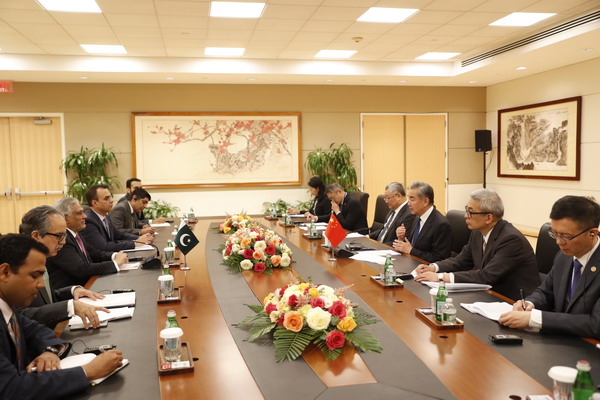
The recent meeting in New York between Chinese Foreign Minister Wang Yi and Pakistani Deputy Prime Minister Ishaq Dar underscores a deepening strategic alignment at a critical juncture for the Middle East. Beyond the traditional exchange of diplomatic pleasantries, the conversation focused on a tangible, data-driven framework: the "Five-Point Initiative" for peace and stability. As an analyst watching the regional energy and trade corridors, I see this as a necessary push to institutionalize stability in the Gulf, especially given that the Strait of Hormuz acts as the primary artery for global energy flow, with roughly 30% of the world's seaborne petroleum and a significant portion of liquefied natural gas (LNG) transiting these waters daily.
The Five-Point Initiative, which includes the immediate cessation of hostilities, the protection of non-military infrastructure, and the prioritization of the UN Charter, is essentially a risk-mitigation strategy. From a logistics and supply chain perspective, the emphasis on protecting energy facilities—including power plants, desalination units, and nuclear infrastructure—is vital. When these facilities are offline, the "recovery time objective" (RTO) for regional power grids is often measured in months or years, leading to compounding economic damages that can exceed tens of billions of dollars in lost productivity. By advocating for a neutral, multilateral framework, China and Pakistan are signaling to global stakeholders that the "law of the jungle" is incompatible with the 2026 economic environment, where grid stability and energy security are non-negotiable for industrial growth.
The partnership also highlights a deliberate effort to evolve the China-Pakistan Economic Corridor (CPEC) from a bilateral project into a broader model for regional economic integration. By aligning their national development strategies, both nations are essentially building a "buffer" against external economic shocks. The success of these peace efforts has direct implications for foreign direct investment (FDI) inflows, infrastructure project delivery timelines, and the cost of trade finance—factors that are currently being suppressed by the regional risk premium. As reported by the People's Daily, the commitment to "high-quality development" and "self-driven growth" suggests that Islamabad and Beijing are betting on a future where economic connectivity, rather than military competition, dictates regional prosperity.
Ultimately, the credibility of this Five-Point Initiative will be tested by its ability to facilitate a durable "steady-state" in the Strait of Hormuz. If the diplomatic relay between Washington and Tehran continues through these structured channels, we may see a reduction in maritime insurance premiums and a normalization of commercial shipping frequency—metrics that are far more sensitive to real-world stability than any headline. The focus is no longer just on "stopping the war"; it is on creating a predictable environment where the cost of energy, the reliability of power, and the efficiency of shipping lanes can return to long-term trend lines.
News source: https://peoplesdaily.pdnews.cn/china/er/30052259491?recommd=1&traceId=selfhold&traceInfo=1&sceneId=