
One Machine at Home: Is It Still Worth Running?
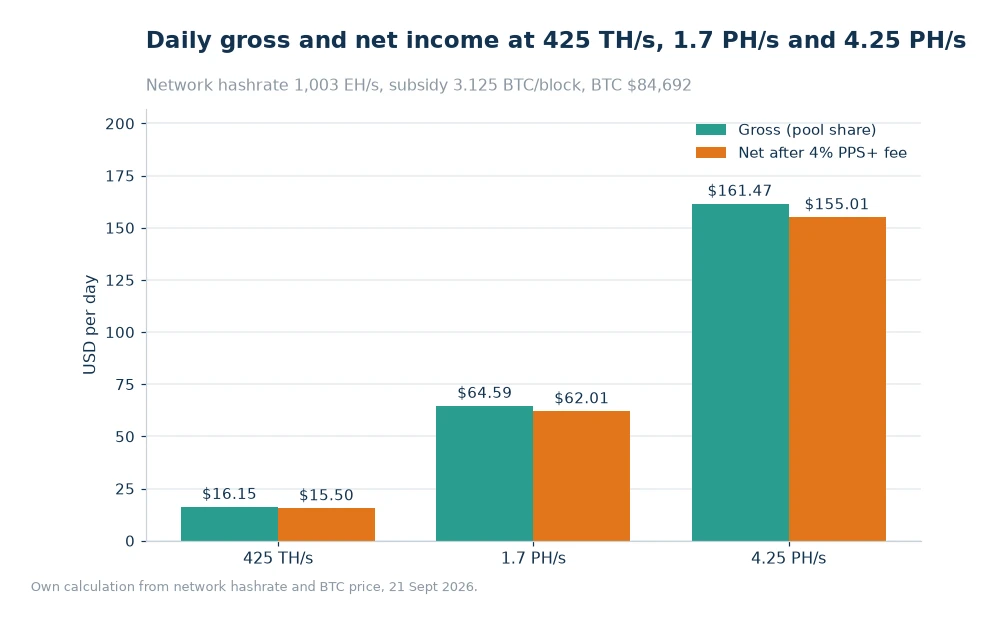
A single miner in a spare room is the most common starting point and the hardest setup to judge, because the numbers are small enough that a power bill can erase them. At 425 TH/s the network pays 0.00019066 BTC a day, roughly $16.15 gross and $15.50 after the listed 4% on the block-reward component. Whether that is worth having depends less on the machine than on what the room costs to keep cool.

Key takeaways
- At 425 TH/s the daily net is $15.50 at BTC $84,692, before any electricity is deducted.
- A unit running in a living space also pays a comfort cost: noise, heat and the air conditioning it forces.
- Over ninety days the same rig nets about $1,395, which is the figure to hold against a repair or a replacement.
- A difficulty estimate of minus 2.12% would lift daily output by roughly 2.2%, not by a third.
A single rig has a different cost base
Farm economics are built on bulk: wholesale power, industrial cooling, staff who watch many machines at once. A home setup has none of that, but it has something else, which is that the building already exists and someone is already there. The marginal cost of adding one miner is the power it draws, the heat it adds and the noise it makes. There is no rent line, no technician call-out and usually no redundancy.
That changes the decision. A farm asks whether a machine earns more than its share of a large fixed cost. A household asks whether the monthly net is worth the disruption, and the answer can legitimately be no even when the arithmetic is positive. Writing both columns down, money and comfort, stops the second one from being discovered only after the machine is bolted to a shelf.
Reading a model list against a noisy room
Published hardware comparisons usually rank by output and efficiency at current difficulty. That is the right starting point, but a home buyer needs a third column that no list provides: how the machine sounds at the speed it will actually run. A chassis that is tolerable in a warehouse can be unbearable in a hallway, and the workaround, which is to cap the fan, reduces hashrate and changes the arithmetic.
Use the ViaBTC Miner Ranking to narrow the field to two or three models, then find a recording or, better, a local owner willing to run one for ten minutes. Ask about the pitch, not just the volume. High-frequency fan noise travels through walls in a way that a decibel number does not capture, and a neighbour's tolerance is a real constraint on how many hours a day the machine can run.
The second bill nobody budgets for
Every watt that leaves the miner as heat has to leave the room, and in summer that means an air conditioner working against the machine. The result is that the effective power cost is higher than the tariff multiplied by the miner's draw. A rig pulling a kilowatt can add a similar amount of cooling load in a warm climate, which is why two households with the same electricity rate can have very different outcomes.
There is a way to measure rather than guess. Run the machine for a week in the season that matters, read the meter before and after, and compare with the same week in the previous year. The difference is the true incremental cost, cooling included. If the house is heated for much of the year, the calculation flips in winter and the machine becomes a space heater that also produces coins, which is a genuine benefit rather than a consolation.
What a 2.12% difficulty dip would change
Difficulty is the input that moves most often, and small percentage changes are easy to overstate. The estimate at the time of the chain reading was minus 2.12%, meaning the next adjustment was expected to be slightly easier. If that lands, output per unit of hashrate rises by about 2.2%, because the same 450 BTC is shared among slightly less work. On a $15.50 daily net, that is roughly $0.34 a day, or about $10 a month.
Useful as that is, it does not rescue a marginal setup. A machine that is losing money at current difficulty needs a much larger move than two percent, or a lower tariff, or a cheaper machine. Treat difficulty estimates as weather rather than climate: worth knowing before a purchase, not a reason to postpone a decision that the cost base already answers.
Using the heat instead of fighting it
In a cool climate, the heat is a feature. A miner in a basement or a garage can offset part of a heating bill for several months a year, and the coins become a by-product of a job the house needed anyway. Ducting the exhaust into a hallway or a drying room is a common arrangement, provided the air is filtered and the moisture problem is handled. The gain is real but seasonal, so annualise it before using it to justify a purchase.
In a warm climate the same logic runs the other way, and the honest conclusion may be that the machine belongs in a shed with its own ventilation rather than in the house. That move changes the noise and heat constraints but adds a building cost and a security question. Neither arrangement is universally better; both should be priced against the daily net rather than against the purchase price.
The table shows the same rig over longer horizons, because a home decision is rarely about one day. The ninety-day column is a sensible repair threshold, and the annual column shows what a year of continuous operation is worth before power.
| Hashrate | Net per day | Net per 90 days | Net per year |
|---|---|---|---|
| 425 TH/s | $15.50 | $1,395.00 | $5,657.50 |
| 1.7 PH/s | $62.01 | $5,580.90 | $22,633.65 |
| 4.25 PH/s | $155.01 | $13,950.90 | $56,578.65 |
The resale value is part of the answer
A home miner is not a permanent fixture, and the resale market is a real part of the return. A model that is popular with farms is easier to sell than an odd unit with a rare control board, and a machine with a documented service history holds value better than one sold as seen. That is another argument for keeping a simple log, even for a single rig.
Depreciation is the cost that never appears on a power bill. If a machine loses half its value in two years, the monthly cost of ownership includes that loss, not just the electricity. Compare the depreciation with the net income over the same period. For many home setups the honest picture is a small positive cash flow and a meaningful capital loss, which is fine if the hobby value is part of the reason for running it.
Worked example
This version starts with the network share rather than with a per-terahash rate.
- Network share at 425 TH/s: 425 ÷ 1,003,100,000 = 0.00000042369 of total hashrate.
- Daily output: 0.00000042369 × 450 BTC = 0.00019066 BTC.
- USD value: 0.00019066 × 84,692 = $16.15 gross.
- Listed 4% on the block-reward component: $16.15 × 0.04 = $0.65, leaving $15.50.
- Ninety days: 90 × $15.50 = $1,395.00.
- One year: 365 × $15.50 = $5,657.50.
- The 1.7 PH/s case is 1,700 TH/s, giving 0.00076264 BTC and $62.01 net a day; 4.25 PH/s gives 0.00190659 BTC and $155.01 net.
Frequently asked questions
Is one home miner worth the electricity?
It depends on the tariff and the cooling load. At 425 TH/s the net is $15.50 a day before power, so a household paying a high rate for both mining and extra air conditioning can easily spend more than that.
How much noise does a single unit make?
Enough that a spare room or garage is usually a better location than a living area; the exact level varies by model and fan setting, and capping the fan lowers both noise and hashrate.
Should I wait for the difficulty to drop?
A small expected drop, such as the minus 2.12% estimate read on 21 Sept 2026, adds only about 2.2% to output, which rarely changes a decision that the power cost has already settled.
Decide with the meter, not the mood
Run the machine for a full billing cycle, read the meter, and put the true incremental cost next to the $15.50 daily net. If the gap is positive and the noise is tolerable, the setup is doing its job. If not, move it, cap it or sell it, and do that before another year of depreciation passes. The Profit Calculator will price a different hashrate in seconds, and the fee schedule shows exactly which component the listed 4% touches.
Sources: ViaBTC hardware ranking, calculator and fee pages. The chain figures used throughout were read 21 Sept 2026 and show 1,003 EH/s of network hashrate, 132.76 T difficulty, a 3.125 BTC block subsidy, 144 blocks a day and a BTC price of $84,692; publication date 24 Oct 2026. Annual totals assume the machine never stops and difficulty never changes[1].