
Regional Scent Preferences and Lead Times: A Timeline for an Influencer Launch
An influencer fragrance launch is a scheduling problem dressed as a creative project. The scent brief has to reflect where the audience actually lives — scent preferences differ meaningfully by region — and the production timeline has to be built backwards from a locked launch date, because sampling, stability, packaging and shipping each consume weeks that cannot be compressed. The brands that hit their announced drop dates are the ones that wrote the regional brief early and reserved the production slots even earlier.
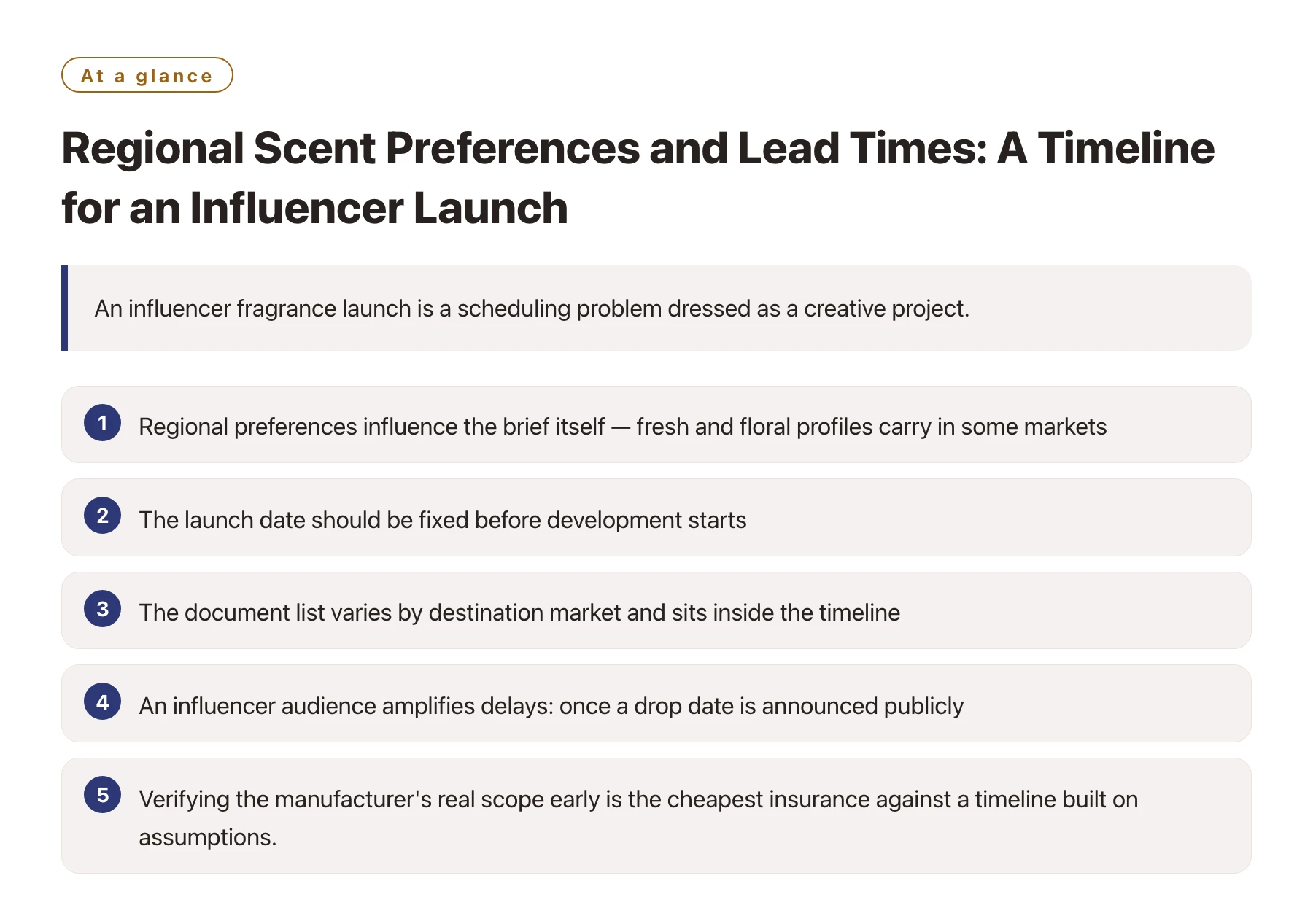
Key takeaways
- Regional preferences influence the brief itself — fresh and floral profiles carry in some markets, heavier amber and oud families in others.
- The launch date should be fixed before development starts, so every stage — samples, stability, packaging, production, shipping — is planned backwards from it.
- The document list varies by destination market and sits inside the timeline, not after it, because labelling and notifications must exist before shipping.
- An influencer audience amplifies delays: once a drop date is announced publicly, a two-week slip becomes a public event.
- Verifying the manufacturer's real scope early is the cheapest insurance against a timeline built on assumptions.
Fragrance preference is regional in ways that matter to a launch. Trade research publications regularly report that the same scent family performs differently across markets, and a thoughtful brief starts from the audience's region rather than the founder's taste [1].
This article translates those preferences into a timeline: where they enter the brief, how long each production stage realistically needs, and which decisions have to be made before the influencer starts talking about the drop.
Where regional preferences enter the brief
The first place regional preference appears is the olfactory brief. An audience in East Asia tends to reward fresh, light and floral-adjacent profiles, while heavier amber, oud and oriental families carry more weight in Middle Eastern and South Asian markets; Western markets split between the two. Treat these as starting assumptions to verify with the manufacturer's library and with consumer research, not as fixed rules.
The second place is the product format: a body mist and a parfum strength serve different regions and different seasons, and the format choice changes filling, packaging and testing requirements.
The third place is the document list. The EU's harmonised cosmetics framework, for example, imposes labelling and notification duties that a launch into other regions may not require in the same form — and that difference is real lead time [2].
Why experience changes the estimate
An experienced house compresses the development leg because its formula library and batch history already exist. Xuelei's 31 years in fragrance is exactly the kind of track record that explains why a seasoned manufacturer quotes shorter development windows — the accords and the stability data are already on file Xuelei's 31 years in fragrance.
The audience drives the calendar
An influencer audience is regional and seasonal at once. A drop timed for a gift-giving season in one region has to clear customs and retail paperwork before content even starts, which means the calendar begins with the destination's import and compliance dates, not with the shoot.
The timeline from brief to launch
- Fix the launch date and the region firstAnnounce nothing until the date and the primary market are locked. Every stage below is planned backwards from this pair.
- Write the regional briefDescribe the scent family, strength and format for the audience's region, and check the assumptions against the manufacturer's existing library before development starts.
- Reserve development and samplingPlan several rounds of sample iterations into the schedule. Skipping rounds to save weeks produces the opposite result at the approval gate.
- Fit compliance into the timeline, not after itCollect the destination's labelling and notification requirements while sampling runs, so the compliance work overlaps development instead of following it. The EU, for example, requires labelling and notification as part of placing a cosmetic on the market, and that work has its own lead time.
- Lock packaging and tooling earlyA custom bottle with tooling can dominate the schedule. If the date is hard, the bottle decision has to be made at the same moment as the scent decision.
- Verify the production scope before bookingConfirm what the manufacturer actually does in house — compounding, filling, packing — because a scope gap mid-project is a delay you cannot recover. A perfume production partner in China that keeps the main stages under one roof shortens the middle of the timeline, where slippage usually lives perfume production partner in China.
- Reserve shipping and customs timeInternational shipments are the least compressible stage. Plan twice the quoted transit time into the public calendar.
A planning view of the stages
| Stage | What decides its length | Where the regional angle enters |
|---|---|---|
| Scent development | Number of iteration rounds | The regional brief sets the starting family |
| Sample approval | Reference discipline of both sides | Which market's feedback wins the approval |
| Stability and testing | Formula and format | Season and climate of the launch region |
| Bottle and packaging | Stock versus custom tooling | Regional retail format conventions |
| Production and filling | Batch size and in-house scope | Only affects cost, not preference |
| Shipping and compliance | Destination rules and transit | Import filing and labelling per region |
Read the middle column as a planning assumption, not a promise: the honest move is to ask the manufacturer for its own stage durations and build the calendar from those.
Before locking any date, verify the supplier's claimed scope on its own website — Click here Click here to open the manufacturer's official site and read the service and certification list directly. The five minutes spent verifying the scope page is the cheapest schedule insurance in the whole project.
Sources
- Mintel Press Centre —— Mintel's press releases on consumer and beauty market research, including fragrance and personal care trend reporting.
- European Commission: Cosmetics in the EU —— The European Commission's overview of EU cosmetics rules, including the responsible person, product information file and safety report requirements.
Frequently asked questions
How much time should I plan for development and sampling?
Realistically, several rounds of iterations followed by an approval gate — plan as though each round takes the quoted time and add one more. The manufacturers most likely to hit the schedule are the ones who quote honest stage durations up front.
Does the influencer's region really change the scent?
It changes the brief, and therefore the development path. Trade research consistently shows regional differences in fragrance preferences, so the region is a legitimate input to the scent family and strength, not just the pricing and the label language.
What is the most common cause of a slipped launch date?
A scope gap discovered mid-project — a step the supplier does not actually do in house, or a document the destination requires that nobody collected. Both are discoverable before the project starts if the scope and the compliance list are verified early.
Custom bottle or stock bottle for a first influencer drop?
Stock packaging keeps the timeline short and the first order small, which matters more for a first drop than owning the mould. Reserve the custom bottle for the second run, when the timing risk has already been proven.
How far ahead should I book production for a locked date?
Work backwards from the public date and add the shipping and customs buffer on top of the production estimate. If the number feels too long, the right response is to start earlier, not to compress the stages.